
The Iraq Stock Exchange operates through a structured electronic trading system where investors submit various order types to buy or sell securities. Understanding how these orders function is essential for executing trades effectively and managing investment strategies in the Iraqi market.
Each order type serves a specific purpose, from executing immediate transactions to setting precise price conditions. Familiarity with these mechanisms helps investors navigate the exchange’s trading rules and optimize their market participation.
General Information on the Operation and Order System of the Iraq Stock Exchange (ISX)
The Iraq Stock Exchange utilizes an automated electronic trading platform that matches buy and sell orders based on price and time priority. Trading sessions operate during specified hours, and all transactions are processed through this centralized system to ensure transparency and fairness.
The exchange order system records every submitted order with details including security name, quantity, price parameters, and validity period. Investors access the platform through licensed brokerage firms that transmit orders to the exchange on their behalf. The system maintains a continuous order book that displays current bid and ask prices for listed securities.
ISX trading rules require all orders to comply with minimum lot sizes and tick size increments specific to each security. The exchange monitors order flow to prevent irregular trading patterns and maintains settlement procedures that finalize transactions within designated timeframes.
Basic Order Types Used in the Iraq Stock Exchange
The Iraq Stock Exchange supports several fundamental order types that accommodate different trading strategies and investor preferences. These orders vary in execution priority, price conditions, and timing requirements.
- Market orders that execute immediately at the best available price
- Limit orders that specify maximum purchase or minimum sale prices
- Day orders that expire at the end of the trading session
- Good-till-cancelled orders that remain active until executed or manually withdrawn
Each order type interacts differently with the order matching engine, affecting execution speed and price certainty. Investors select order types based on their urgency, price sensitivity, and market conditions at the time of submission.
What is a Market Order?
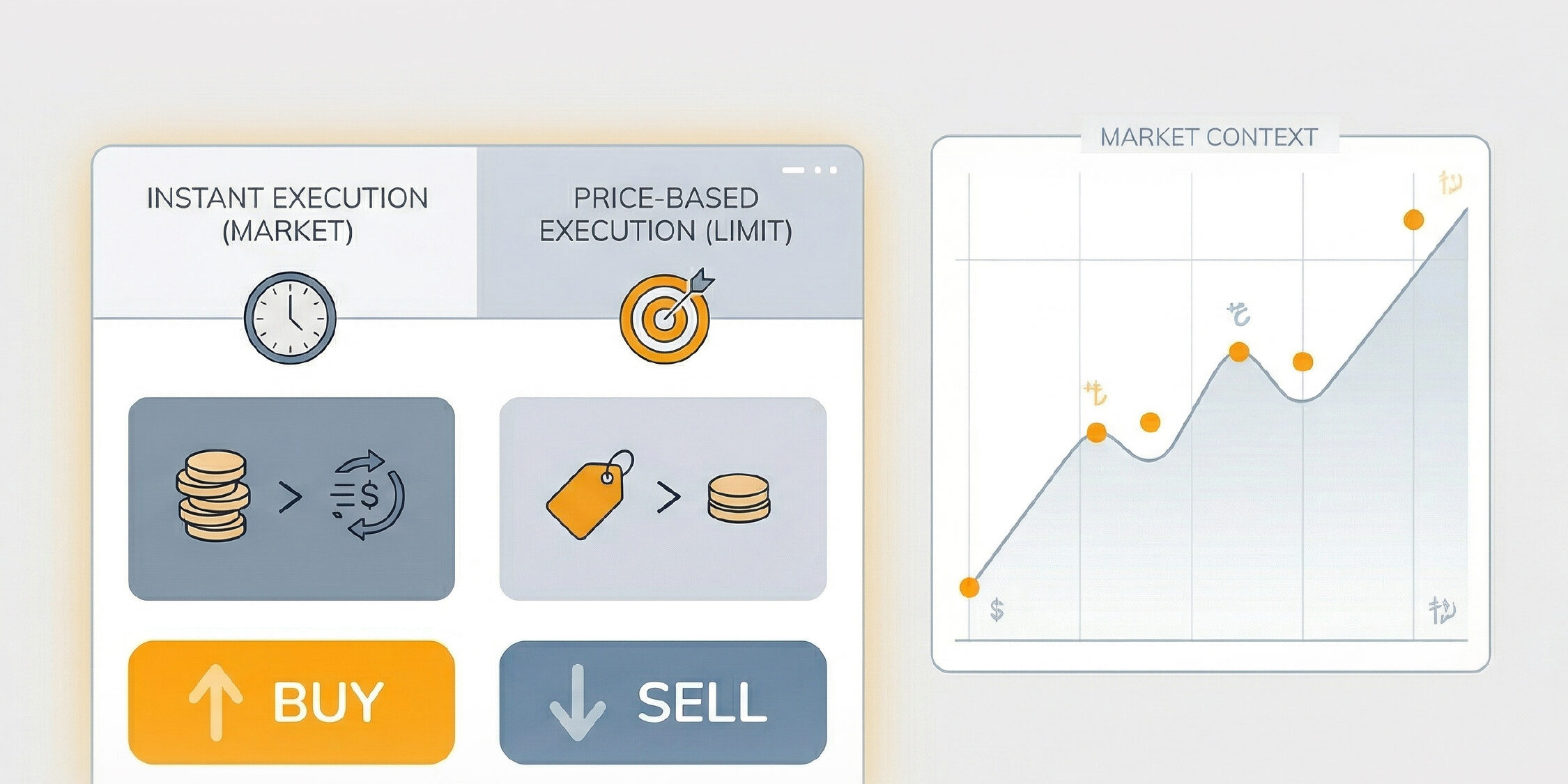
A market order instructs the exchange to execute a trade immediately at the current best available price. This order type prioritizes speed over price control, making it suitable when investors want guaranteed execution without delay.
When a market buy order enters the system, it matches with the lowest available sell order. Conversely, a market sell order matches with the highest available buy order. The final execution price depends on the order book depth at the moment of submission.
Market orders offer near-certain execution during active trading periods but may result in unexpected prices during volatile conditions or for securities with limited liquidity. Investors typically use market orders when the current price is acceptable and immediate execution outweighs price precision.
What is a Limit Order?
A limit order specifies the maximum price an investor will pay when buying or the minimum price they will accept when selling. This order type provides price control but does not guarantee execution if the market never reaches the specified limit.
Buy limit orders execute only at the limit price or lower, while sell limit orders execute only at the limit price or higher. The order remains in the system until it matches with a counterparty willing to trade at the specified price or better, or until the order expires based on its order validity period.
Limit orders allow investors to set precise entry and exit points, protecting against unfavorable price movements. However, if the security’s price moves away from the limit, the order may remain unfilled indefinitely. This order type suits investors who prioritize price certainty over execution certainty.
Partial Matching Orders
Partial matching occurs when an order executes in multiple transactions rather than as a single complete fill. This happens when the available quantity at the desired price is insufficient to fulfill the entire order volume.
The exchange order system fills the available portion immediately and keeps the remaining quantity active in the order book. Subsequent matches occur as additional counterparties submit compatible orders. Investors may receive multiple execution confirmations for different portions of the same original order.
Partial fills are common in securities with lower trading volumes or when large orders exceed typical transaction sizes. Investors can specify whether they accept partial execution or require all-or-none fulfillment, though the latter option may significantly reduce execution probability.
Examples of Use in Buy and Sell Orders
Consider an investor wanting to purchase shares of a company currently trading at a specific price level. Submitting a market buy order would execute immediately at the lowest available ask price, ensuring the investor acquires the shares without delay, but accepting whatever price the market offers at that moment.
Alternatively, the same investor could submit a limit buy order at a price below the current ask, waiting for the market to decline to that level. If sellers eventually accept that price, the order executes; if the price never falls that far, the order remains unfilled.
For selling, an investor holding shares might use a market sell order to exit a position quickly, accepting the highest current bid. A limit sell order would instead specify a minimum acceptable price, executing only when buyers are willing to meet that threshold. These choices reflect different priorities between execution certainty and price optimization.
Differences Between Market Orders and Limit Orders
Market orders and limit orders represent fundamentally different approaches to trade execution, each with distinct advantages and limitations. The primary difference lies in the trade-off between execution certainty and price control.
- Execution Priority: Market Order (Immediate execution) vs. Limit Order (Execution only at specified price or better)
- Price Certainty: Market Order (Unknown until execution) vs. Limit Order (Guaranteed not to exceed limit)
- Execution Certainty: Market Order (High during normal trading) vs. Limit Order (Dependent on market reaching limit price)
- Best Use Case: Market Order (When speed matters) vs. Limit Order (When price matters)
Market orders suit situations requiring immediate position changes, while limit orders benefit investors with specific price targets and patience to wait for favorable conditions. Understanding these differences helps investors select appropriate order types for their trading objectives.
Order Validity Periods and Implementation Rules
Every order submitted to the Iraq Stock Exchange includes a order validity period that determines how long it remains active in the trading system. The most common validity types are day orders and good-till-cancelled orders.
Day orders automatically expire at the end of the trading session if not executed, requiring investors to resubmit them for subsequent sessions. Good-till-cancelled orders remain active across multiple trading days until either executed or manually cancelled by the investor, though exchanges typically impose maximum validity periods for system management.
ISX trading rules govern how orders interact with corporate actions such as dividends, stock splits, and rights issues. Orders may be automatically adjusted or cancelled when such events affect the underlying security. Investors should verify order status after corporate actions to ensure their instructions remain appropriate.
The exchange also enforces price limit rules that restrict how far orders can deviate from the previous closing price, preventing erroneous submissions from disrupting orderly trading. Orders exceeding these limits are rejected and must be resubmitted within acceptable parameters.
How Does the Order Matching Mechanism Work in the Iraq Stock Exchange?
The order matching mechanism at the Iraq Stock Exchange operates on a price-time priority algorithm. This system first matches orders based on the best available price, then uses submission time as the secondary criterion when multiple orders exist at the same price level.
Buy orders are ranked from highest to lowest price, while sell orders are ranked from lowest to highest. The matching engine continuously compares the highest buy order with the lowest sell order. When these prices overlap or meet, a transaction occurs at the price that satisfies both parties according to the priority rules.
The process works as follows: incoming market orders match immediately with the best available counter orders. Limit orders enter the order book at their specified prices and wait for compatible orders. As new orders arrive, the system re-evaluates potential matches and executes trades whenever conditions align.
This continuous matching process ensures efficient price discovery and fair execution for all participants. The electronic system processes matches within milliseconds, maintaining an orderly market even during periods of high trading activity. Transparency is maintained through real-time dissemination of executed trade prices and volumes.
Points to Consider in Order Management for Investors
Effective order management requires investors to consider several factors before submitting instructions to the exchange. Understanding current market conditions, including liquidity levels and price volatility, helps determine which order types best suit specific situations.
Investors should verify order details carefully before submission, as errors in quantity, price, or order type can result in unintended executions. Many trading platforms require confirmation steps to prevent accidental submissions, but ultimate responsibility rests with the investor.
- Monitor order status regularly to track partial fills and pending orders
- Adjust or cancel orders when market conditions change significantly
- Consider trading volumes when sizing orders to avoid excessive market impact
- Account for validity periods to ensure orders remain active as intended
- Review execution reports to confirm trades match submitted instructions
Investors should also maintain awareness of the exchange’s trading hours and any scheduled interruptions. Orders submitted outside trading hours typically queue for the next session’s opening, potentially executing at significantly different prices if overnight news affects the security.
Working closely with licensed brokers provides access to professional guidance on order strategy and execution techniques. Brokers can explain how different order types interact with current market conditions and help investors develop approaches aligned with their investment objectives and risk tolerance.
Effective Trading on the Iraqi Stock Exchange with Rabee App
Rabee App is the first smartphone application in Iraq that allows you to buy and sell shares of companies traded on the ISX online in a secure and easy way. Available for free download from the Apple Store and Google Play in both Arabic and English, the app offers investors numerous advantages. Providing a virtual trading environment for beginner users, Rabee App simplifies stock trading, allows users to track company prices, news, and stock market indices. Users can manage their portfolios, track updates to placed orders, and utilize the app’s integrated e-payment services. Furthermore, you can open a trading account and easily contact technical support and customer service through the Rabee App.